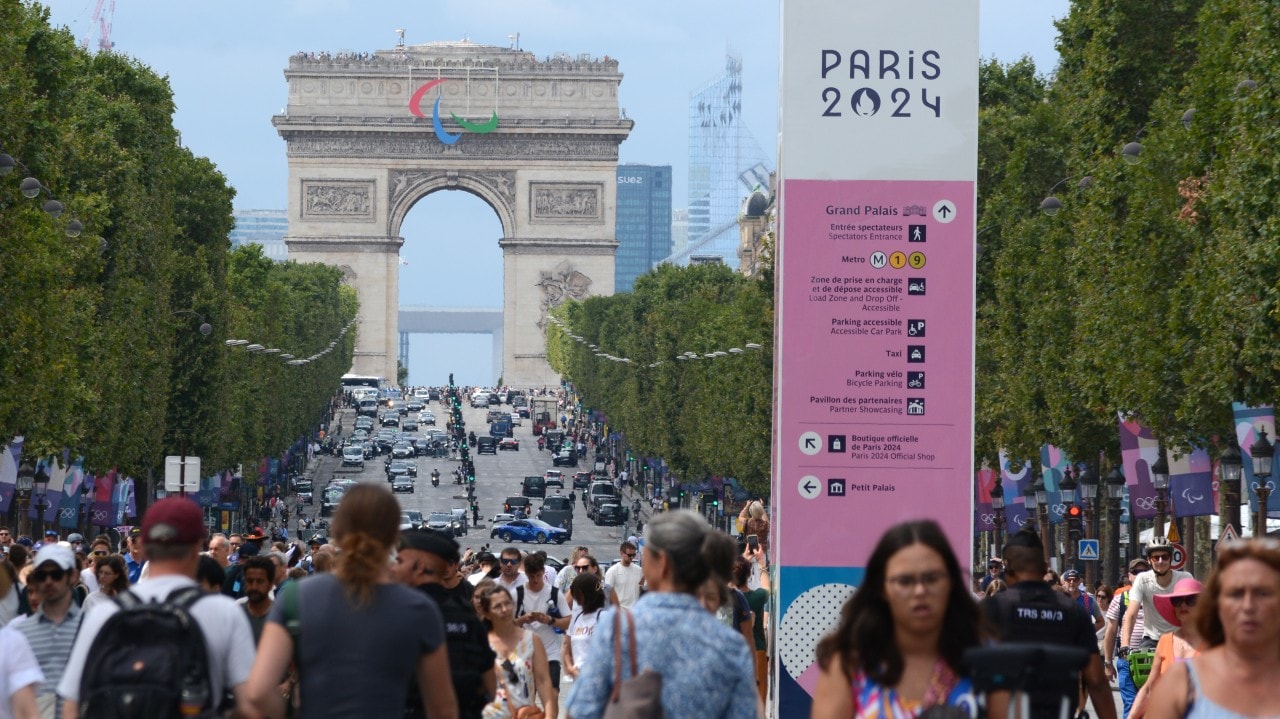
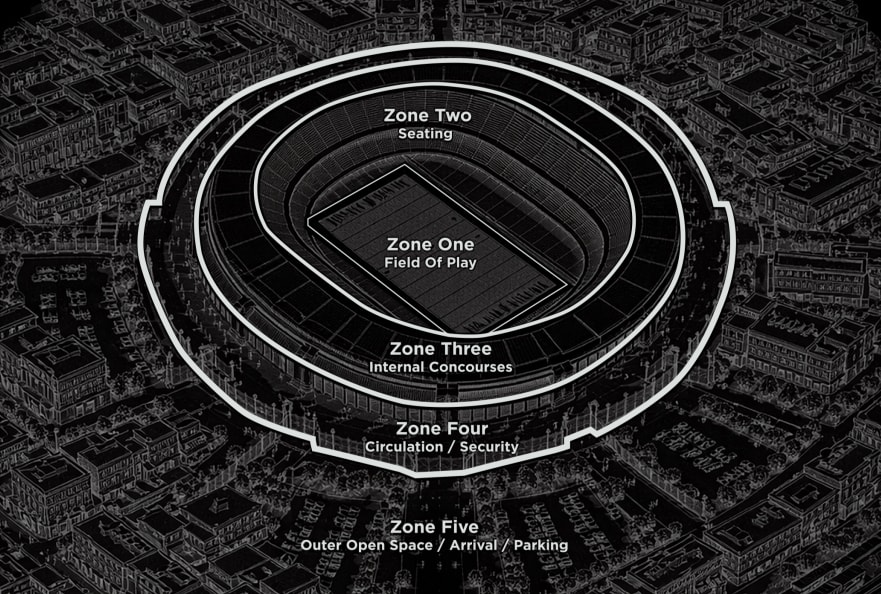
User-centered design is rooted in empathy, an effort to understand the world from someone else's perspective before making decisions that affect their experience. The modern practice of user-centered design gained prominence through the work of Tim Brown and David Kelley at IDEO, where it was initially developed to improve products by deeply understanding the needs, behaviors, and challenges of users. But the philosophy behind it, solving problems by first stepping into the user's shoes, is not limited to industrial design or user-interface design. It is equally powerful when applied to the design of spaces, environments, and systems. In complex public venues, user-centered design provides a way to address challenges not from the standpoint of the organization, but from the perspective of the people moving through complex spaces.
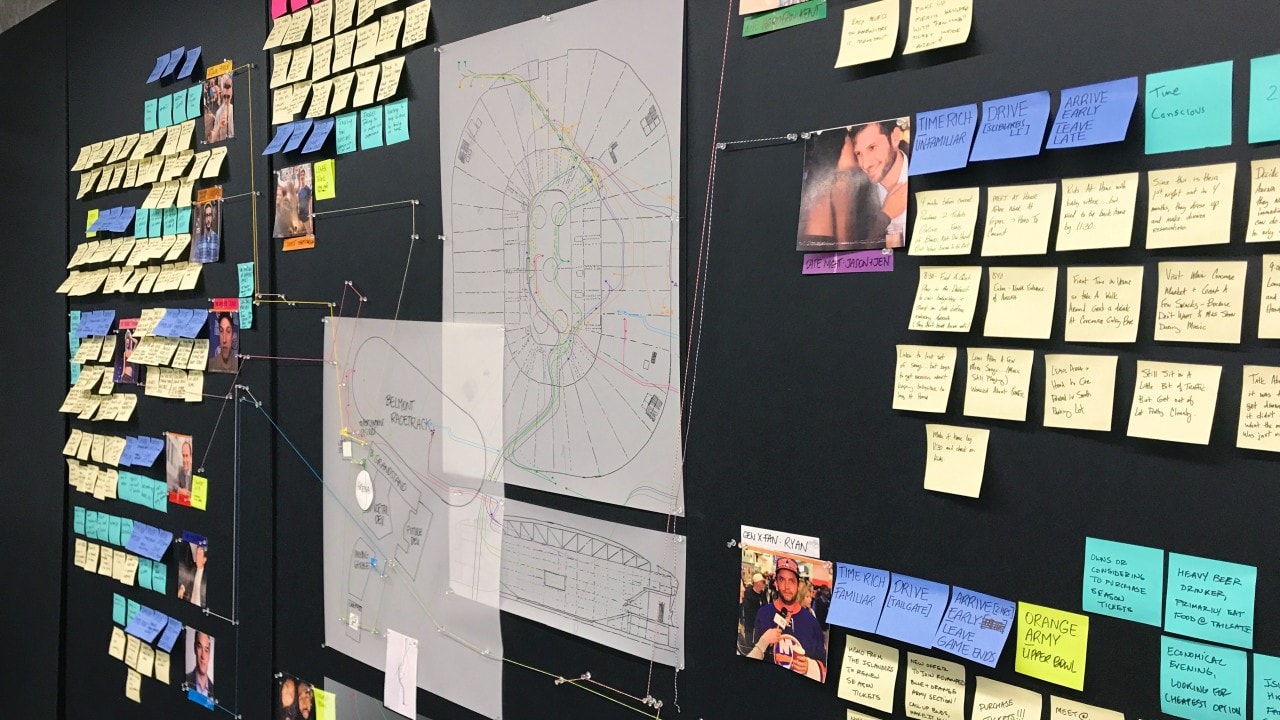
The principles and methodology of human-centered design can be applied to plan and implement wayfinding strategies rooted in real human behavior. This process begins with the observation of how individuals interact with the built environment, identifying moments of hesitation, areas where visual cues are sought, and points where confusion arises. These qualitative observations are then synthesized through tools such as persona development and journey mapping, which help expose friction points that signage or spatial design alone may not resolve. In parallel, quantitative patterns of behavior, including repeated actions, along with qualitative inputs such as interviews and user questions, provide measurable and descriptive evidence that strengthens design recommendations. By combining qualitative insight with quantitative data, wayfinding solutions can be developed that are not only thoughtful but also evidence-based. In a discipline often viewed as subjective or aesthetic, grounding decisions in user data supports consensus building and enables a defensible position in the creation of solutions that respond to clearly defined user needs.
The pages that follow will explore the foundational tools that support a user-centered approach to wayfinding, including persona creation and journey mapping. At this stage, it's important to emphasize the principle that underlies them all: empathy. Designing for others means suspending assumptions and listening with our eyes, not just our ears. When we make the effort to observe a place as if we were unfamiliar with it, and to analyze how people experience it in real time, we begin to see the disconnects between intention and experience. It is in those moments of disconnection that the need for thoughtful, evidence-based wayfinding becomes most clear, and our ability to defend design decisions becomes significantly stronger.
It can be tempting, especially under the pressure of tight schedules or the excitement of creative work, to jump straight to design solutions. But skipping the foundational step of understanding users through observation and research is the fastest way to end up with a beautiful system that simply doesn’t work. Astonishingly, awards are bestowed upon beautiful wayfinding systems that have little benefit to users’ needs every year. Over the years, I’ve received countless calls from venue operators of newly built or renovated stadiums, arenas, ballparks, and facilities where the architecture is world-class and the signage looks polished, but the wayfinding system fails the people who rely on it. Fans get lost, staff fields unnecessary questions, and operations are slowed because the system was built around assumptions and aesthetics rather than insights. If there is one takeaway from this book, it's this: putting the user first is not optional. Design can, and should, be inspiring and engaging, but if it doesn’t support intuitive navigation and ease of use, it’s just a pretty sign with no function. The true value of a wayfinding system lies in how well it works, not just how good it looks.


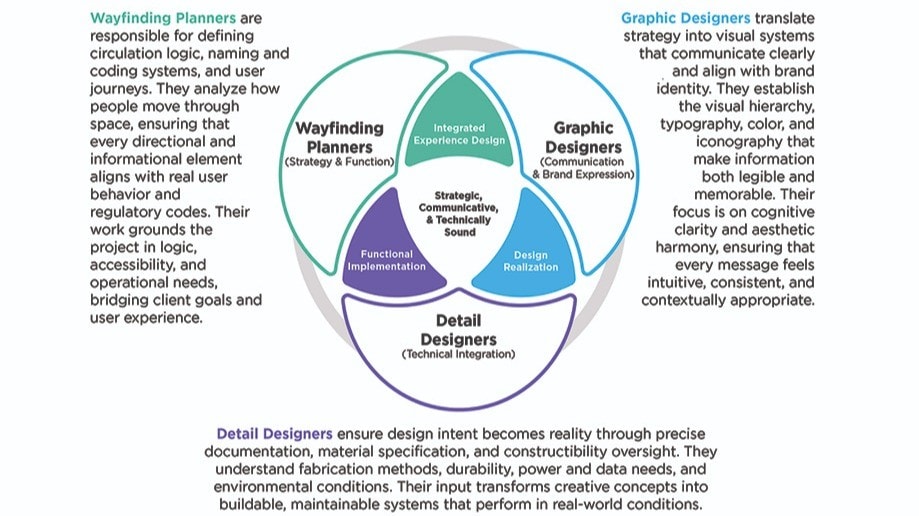
Every successful wayfinding project starts with the right team. Yet in many design firms, one person is expected to fill every role, planner, designer, and detailer all at once. That may work for small projects, but in large-scale environments, specialization leads to far stronger results. Through three decades of developing wayfinding systems across some of the most complex cities and venues in the world, I’ve seen firsthand how specialization consistently produces better outcomes than the all-in-one approach. The most successful results come from teams built around complementary expertise: wayfinding planners who understand spatial logic and user movement, graphic designers who craft clear and expressive visual systems, and detail technical designers who translate ideas into technically sound, buildable solutions. Each discipline contributes a vital layer of expertise that, together, transforms strategy into meaningful user experiences.
Most people who enter the field of wayfinding come to it fresh, seeking knowledge in a discipline with few formal resources. Practitioners often arrive from related backgrounds, such as architecture, interior design, industrial design, psychology, environmental design, landscape architecture, or UX design. Each brings a valuable perspective but also significant gaps in understanding how to plan, coordinate, and execute complex wayfinding systems. Until now, much of this knowledge has been passed down informally through mentorship, trial, and apprenticeship. The Science of Wayfinding breaks that barrier by offering a detailed framework that explains the entire process from strategy to implementation, giving practitioners a foundation to build upon rather than having to reinvent it through experience.
As an example, the Collaborative Framework Venn, featured in Chapter 6: A Structured Approach, illustrates how these disciplines intersect to create systems that are strategic, communicative, and technically robust. Wayfinding planners interpret the architecture, defining circulation patterns, movement logic, naming and coding systems, and user journeys. Graphic designers translate that logic into system design, establishing visual hierarchy, typography, and iconography that make navigation intuitive and memorable. Detail designers ensure the vision becomes reality by specifying materials and finishes, ensuring durability, and overseeing constructability. When these disciplines work in harmony, the result is more than a coordinated set of signs; it is a holistic, transparent process that encourages collaboration, ownership, and shared purpose. This integrated approach is also more efficient, enabling teams to deliver higher-quality work in less time by leveraging each specialist’s strengths and aligning effort where it has the most impact.
This structured process of design aligns wayfinding with the broader creative and technical workflow of large-scale projects. It demonstrates how the overlap between planning, design, and documentation yields both efficiency and excellence. In an era where environments are growing more complex and expectations for user experience are higher than ever, this approach offers a proven way forward. It references insights from my forthcoming book The Science of Wayfinding, to be published next year, which aims to support designers seeking a clearer process for planning and delivering effective wayfinding systems.

Some of the most popular television shows, such as The Bachelor or American Idol, rely on an intentional narrative structure that is engineered around uncertainty. Each episode delays resolution, by ending each week with unanswered questions about outcomes, choices, and consequences. Viewers remain engaged not because of constant action, but because the story is left unfinished. Anticipation itself becomes part of the experience, and the eventual moment of resolution feels disproportionately satisfying.
This dynamic is explained by a well-established principle in cognitive psychology known as the Zeigarnik Effect. Originating from the work of psychologist Bluma Zeigarnik, the research aligns with our tendency to remember uncompleted tasks more vividly than completed ones. In her experiments, participants were asked to perform simple activities, some of which were intentionally interrupted. When later asked to recall the tasks, people consistently remembered the unfinished ones more clearly. Zeigarnik proposed that incomplete tasks create a state of cognitive tension that persists until closure, keeping the task active and prominent in memory. Once completed, that tension dissipates and the memory weakens.
Additional research has supported and refined this idea. While the effect is strongest when individuals are personally invested in the outcome, the core insight remains highly relevant to navigational wayfinding (Baddeley, 2003). This research demonstrates that the human brain prioritizes unresolved goals. Attention increases when outcomes are uncertain, and memory strengthens during periods of active problem solving.
Navigating an unfamiliar building, campus, or city is not a passive activity. It is an ongoing sequence of open and closed journeys. When people enter a complex environment, their spatial understanding is incomplete and provisional. Questions such as Where am I, Which direction should I take, and Am I still on the right path remain unresolved until progress is confirmed. Each decision point heightens attention, much like the delayed resolution of outcomes in storytelling, aligning closely with the Zeigarnik Effect.
Landmarks, thresholds, and signage encountered at these moments become more memorable because they are experienced during active problem solving. When a sign confirms the correct route or a destination comes into view, the task temporarily closes. Confidence increases, cognitive load decreases, and the experience is reinforced in memory. These moments of relief are central to how people learn to navigate built environments.
Over time, repeated cycles of experience of places form cognitive maps within the hippocampus. Rather than remembering entire environments in detail, people remember sequences of problems solved. As awareness increases, navigation shifts from effort to familiarity. This explains why first time visitors depend heavily on explicit information such as signs and maps, while experienced users move efficiently by reading the environment itself.
More of these principles, drawn from research in environmental psychology and real world observation, are explored in my upcoming book, The Science of Wayfinding, which examines how people think, feel, and behave as they move through large scale environments.
In the race toward “smart environments,” digital wayfinding tools—mobile apps and interactive websites—are often pitched as the future of guest navigation. Their advocates tout them as seamless, scalable, and smart. But recent data from two of the nation’s most prominent stadium and event venues, both of which serve millions of visitors annually, reveal a critical reality: mobile-based wayfinding tools consistently reach less than 15% of patrons. In these venues—each with major investments in web/app-based platforms—actual usage rates for navigation hovered at just 11% and 13% over a full calendar year. The conclusion is clear: these tools are not reaching the majority of users.
While I specialize in physical wayfinding systems, I too have shared in the excitement about the potential of digital wayfinding—particularly app-based tools that promised personalized, responsive, and scalable navigation experiences. Like many, I saw an opportunity to enhance guest journeys through mobile technology. But with the benefit of data from high-volume venues and real-world guest behavior, I’ve come to better understand where digital tools shine—and where they fall short.
In learning from this data, I now view digital and physical wayfinding not as competing solutions, but as complementary ones, each with distinct strengths. Mobile platforms can be powerful for pre-event planning, parking, or last-minute changes. But inside the venue—where people are distracted, multitasking, and on the move—physical wayfinding remains the most immediate, intuitive, and universal guide. Good design doesn’t ask users to opt in; it just works.
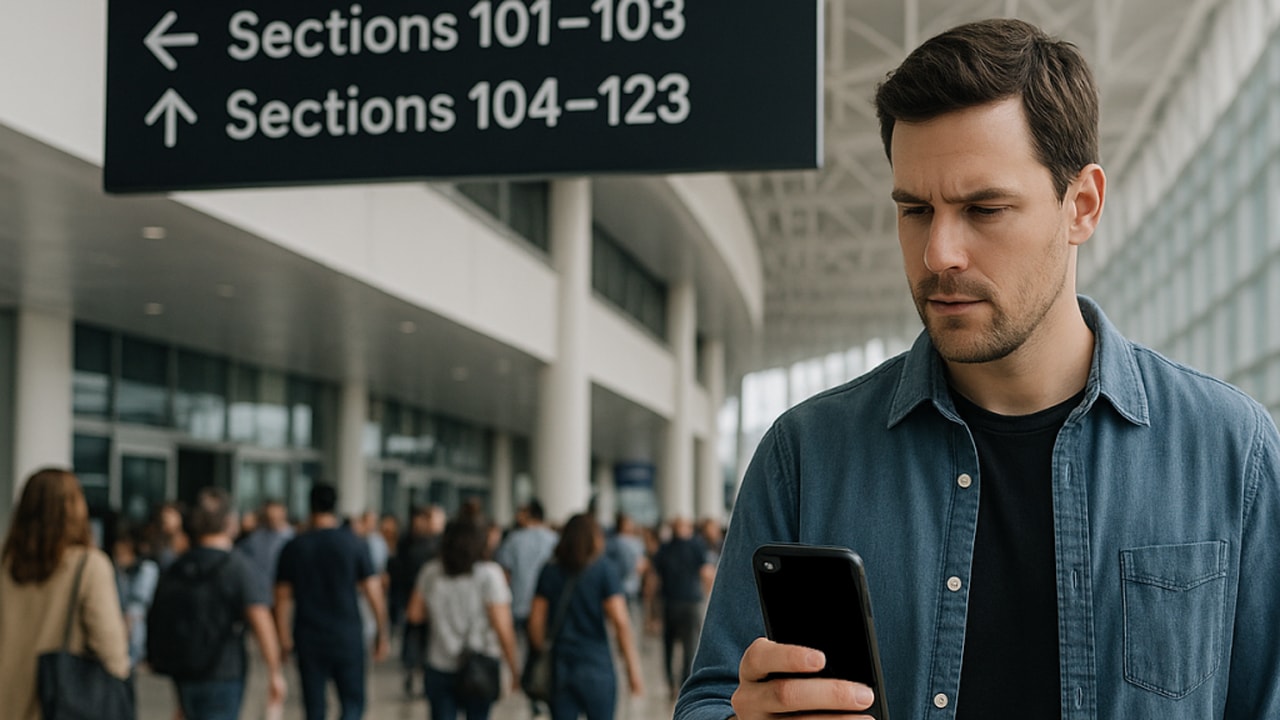
This isn’t a rejection of digital convenience—it’s a reflection of human behavior in complex, high-energy spaces. The decision to navigate isn’t made in a vacuum. It happens while guests are juggling bags, drinks, friends, or children. In those moments, they don’t reach for their phones, navigate through menus, and interpret a digital map. They look up. They scan their environment for signs, landmarks, movement cues—anything that offers immediate clarity without friction. That’s where physical wayfinding succeeds. It meets people where they are, using environmental design to deliver fast, intuitive information that works for all users, regardless of tech literacy or language.
Stadium and event wayfinding isn’t just about finding the shortest path—it’s about reducing stress, managing crowd momentum, and delivering a safe, confident experience for every visitor. When nearly nine out of ten guests don’t use the venue’s navigation app, their reliance on physical cues becomes not just common, but essential. Ignoring this reality puts operational flow, guest satisfaction, and even safety at risk. Signage systems, environmental landmarks, and spatial logic aren’t decorative—they’re infrastructure. They form the backbone of how people orient, circulate, and experience a space.
Smartphone tools do have value—especially for pre-event planning, vehicular routing, or crowd-responsive text updates—but they must complement, not replace, physical systems. Mobile apps cannot substitute for intuitive design. The data makes this undeniable: relying on app-based navigation alone serves only a sliver of your audience. If 87% of your patrons aren’t using mobile tools to find their way, the issue isn’t adoption—it’s a misalignment between design strategy and real-world user needs.


One of the most interesting aspects of wayfinding planning is how different the process becomes when designing for a new venue versus improving an existing one. New builds offer the opportunity to shape navigation from the beginning through circulation planning, naming systems, sightlines, architecture, and environmental cues. The challenge, however, is that many operational decisions are still evolving during design. In some cases, the venue operator has not even been hired yet, making it difficult to validate how spaces will truly function on event day or how naming and operational strategies will ultimately be used.
Existing venues present a very different set of challenges. Legacy naming systems, years of operational workarounds, outdated architectural files, phased renovations, sponsorship overlays, and inconsistent circulation patterns often create layers of complexity that were never originally planned together. At the same time, existing facilities usually come with experienced operational staff who understand the venue intimately. That institutional knowledge is incredibly valuable, but it can also make it harder to identify opportunities beyond what has become familiar over time. Some of the most meaningful wayfinding improvements begin by questioning assumptions that have simply become accepted as “the way the building works.”
Chapter 6 of my book, The Science of Wayfinding, explores the structured planning process behind both new and existing environments and the very different challenges they present. Whether working on a new stadium, convention center, airport, entertainment district, or historic venue retrofit, the goal remains the same: creating environments that feel intuitive, reduce stress, and help people move with confidence. The Science of Wayfinding releases this August. Preorder link in comments.
Wayfinding is not just a design task. It is a psychological and emotional process shaped by how people perceive, interpret, and navigate the world around them. Environmental psychology helps explain why people drift toward certain pathways, how they interpret spatial cues, and why some environments feel intuitive while others feel confusing or stressful. In high complexity places like stadiums, campuses, airports, convention centers, and urban districts, these behavioral patterns shape every moment of the user experience.
Effective wayfinding planning requires an understanding of how people form spatial knowledge, how stress affects navigation, and how age, cultural background, neurodiversity, or urgency influence decision making. It requires knowing how visual attention shifts in motion and how memory is processed, recalled, and sometimes distorted while navigating. Good design anticipates these moments rather than reacting to them.
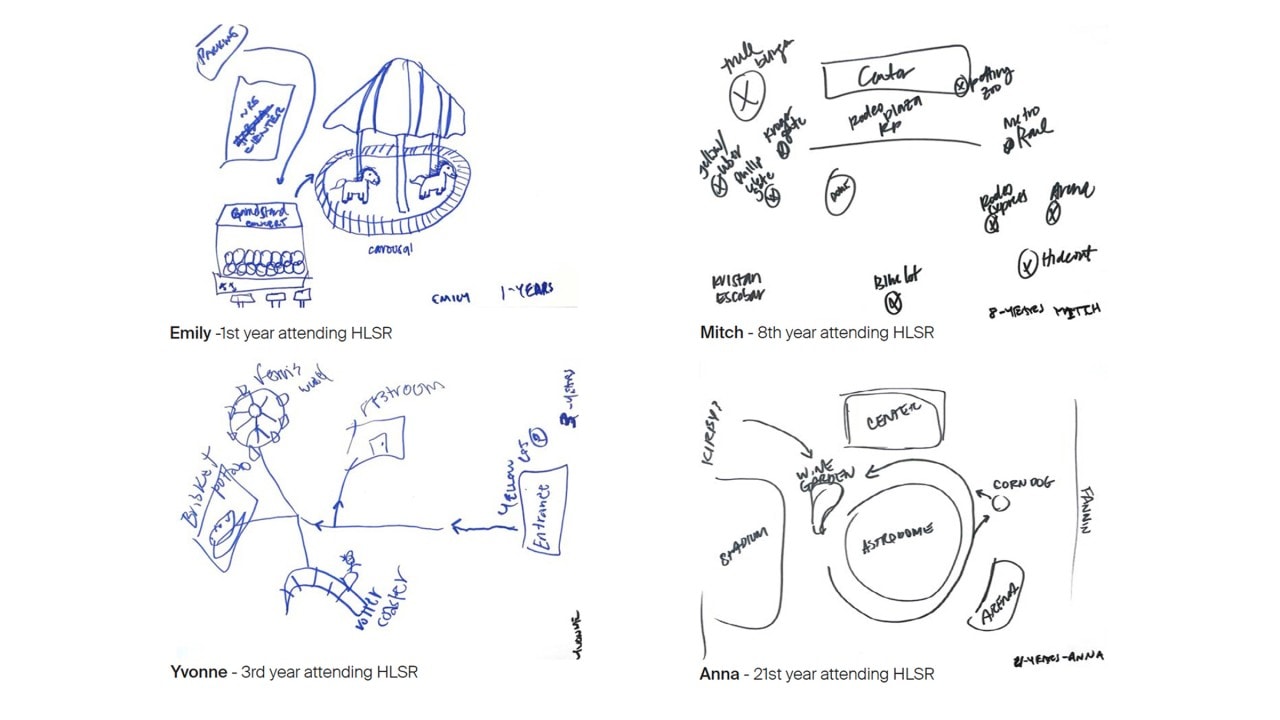
Cognitive mapping is one of the many psychological processes explored in my upcoming book The Science of Wayfinding. People do not carry around floor plans in their heads. They build mental maps over time, formed through experience, perception, and attention. These internal maps are personal, imperfect, and often emotionally driven. Yet they guide every decision a person makes as they move through a place and determine whether a space feels clear or overwhelming.
The sketches shown here were created during user research at the Houston Rodeo, which welcomes over three million visitors every March and creates a uniquely complex environment for wayfinding, revealing how differently people perceive the same space. First time visitors like Emily capture only strong visual landmarks, illustrating limited spatial structure. Repeat attendees like Mitch and Anna draw richer, more connected maps that reflect years of accumulated knowledge, memories, and orientation cues. These sketches demonstrate a simple truth. The more familiar we become with a place, the more complete and confident our mental map becomes.
Understanding how these maps form is essential to creating environments that feel intuitive. When we design for how people think and behave, not just how spaces look, we create places that communicate clearly and support confidence at every step.

We use cookies to analyze website traffic and optimize your website experience. By accepting our use of cookies, your data will be aggregated with all other user data.