Article
How Unfinished Journeys Hold Our Attention
Some of the most popular television shows, such as The Bachelor or American Idol, rely on an intentional narrative structure that is engineered around uncertainty. Each episode delays resolution, by ending each week with unanswered questions about outcomes, choices, and consequences. Viewers remain engaged not because of constant action, but because the story is left unfinished. Anticipation itself becomes part of the experience, and the eventual moment of resolution feels disproportionately satisfying.
This dynamic is explained by a well-established principle in cognitive psychology known as the Zeigarnik Effect. Originating from the work of psychologist Bluma Zeigarnik, the research aligns with our tendency to remember uncompleted tasks more vividly than completed ones. In her experiments, participants were asked to perform simple activities, some of which were intentionally interrupted. When later asked to recall the tasks, people consistently remembered the unfinished ones more clearly. Zeigarnik proposed that incomplete tasks create a state of cognitive tension that persists until closure, keeping the task active and prominent in memory. Once completed, that tension dissipates and the memory weakens.
Additional research has supported and refined this idea. While the effect is strongest when individuals are personally invested in the outcome, the core insight remains highly relevant to navigational wayfinding (Baddeley, 2003). This research demonstrates that the human brain prioritizes unresolved goals. Attention increases when outcomes are uncertain, and memory strengthens during periods of active problem solving.
Navigating an unfamiliar building, campus, or city is not a passive activity. It is an ongoing sequence of open and closed journeys. When people enter a complex environment, their spatial understanding is incomplete and provisional. Questions such as Where am I, Which direction should I take, and Am I still on the right path remain unresolved until progress is confirmed. Each decision point heightens attention, much like the delayed resolution of outcomes in storytelling, aligning closely with the Zeigarnik Effect.
Landmarks, thresholds, and signage encountered at these moments become more memorable because they are experienced during active problem solving. When a sign confirms the correct route or a destination comes into view, the task temporarily closes. Confidence increases, cognitive load decreases, and the experience is reinforced in memory. These moments of relief are central to how people learn to navigate built environments.
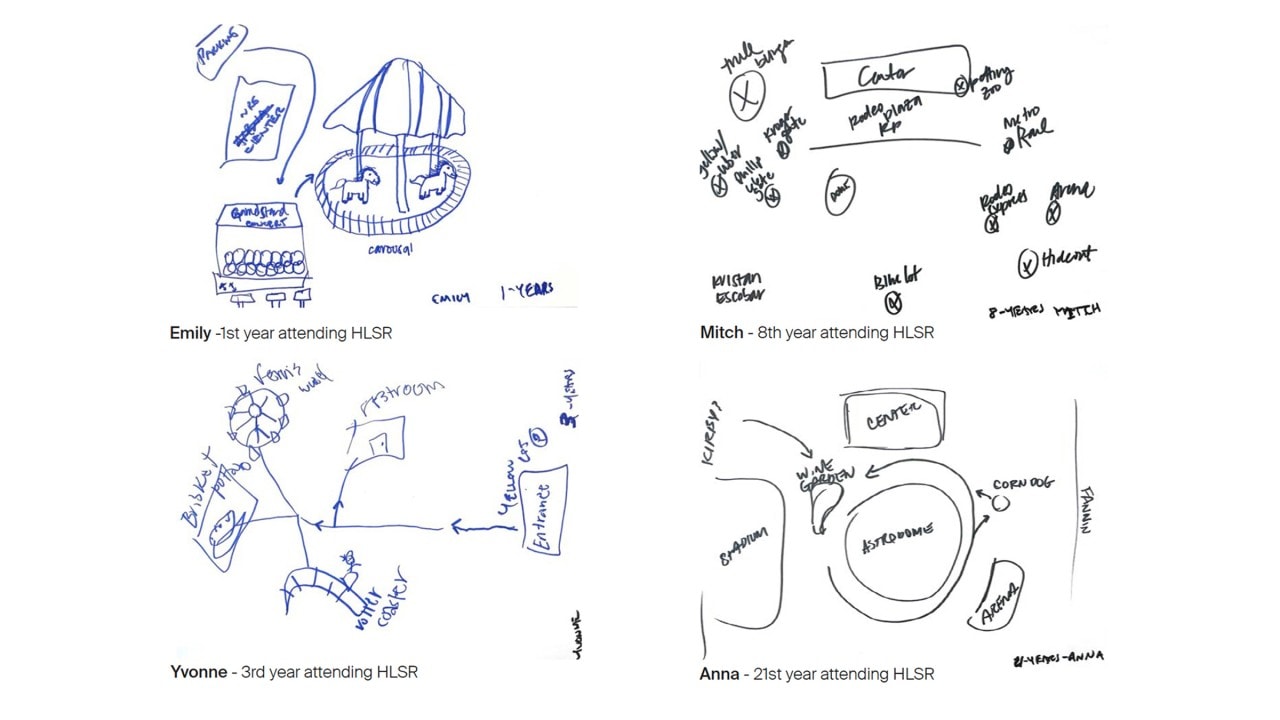
Over time, repeated cycles of experience of places form cognitive maps within the hippocampus. Rather than remembering entire environments in detail, people remember sequences of problems solved. As awareness increases, navigation shifts from effort to familiarity. This explains why first time visitors depend heavily on explicit information such as signs and maps, while experienced users move efficiently by reading the environment itself.