Article
User Experience in Wayfinding
User-centered design is rooted in empathy, an effort to understand the world from someone else's perspective before making decisions that affect their experience. The modern practice of user-centered design gained prominence through the work of Tim Brown and David Kelley at IDEO, where it was initially developed to improve products by deeply understanding the needs, behaviors, and challenges of users. But the philosophy behind it, solving problems by first stepping into the user's shoes, is not limited to industrial design or user-interface design. It is equally powerful when applied to the design of spaces, environments, and systems.
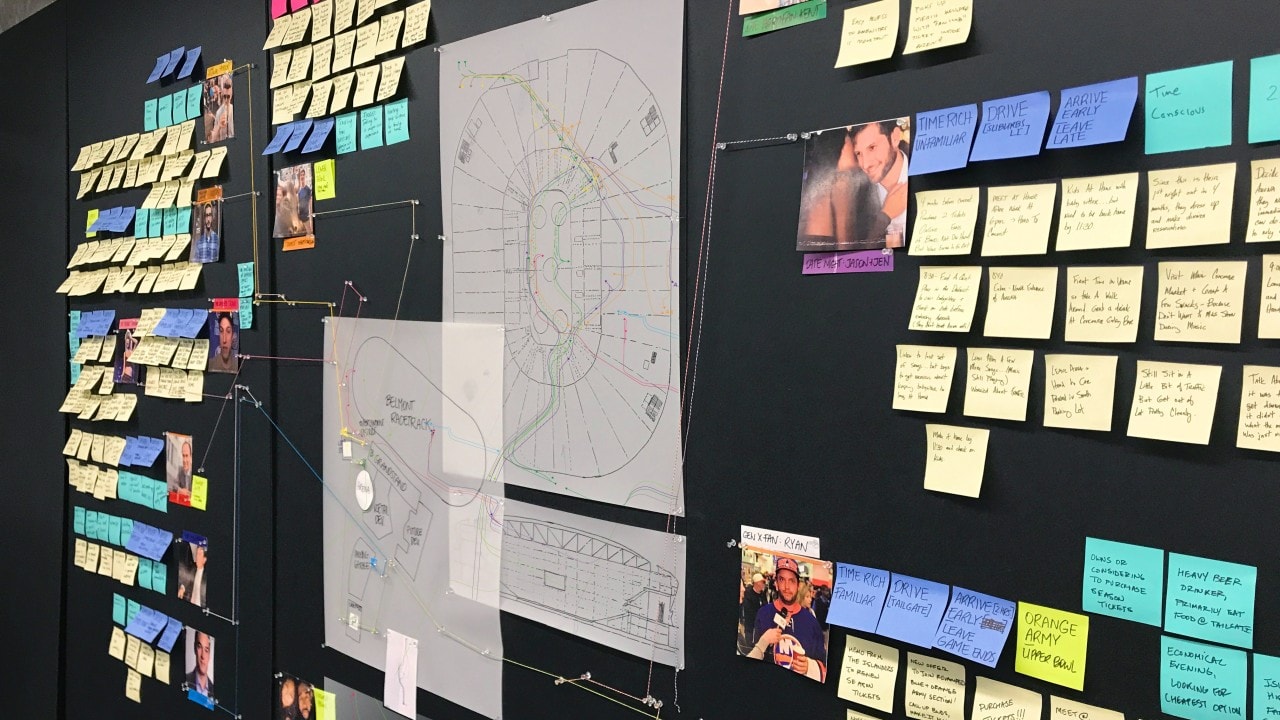
In complex public venues, user-centered design provides a way to address challenges not from the standpoint of the organization, but from the perspective of the people moving through complex spaces. The principles and methodology of human-centered design can be applied to plan and implement wayfinding strategies rooted in real human behavior. This process begins with the observation of how individuals interact with the built environment, identifying moments of hesitation, areas where visual cues are sought, and points where confusion arises. These qualitative observations are then synthesized through tools such as persona development and journey mapping, which help expose friction points that signage or spatial design alone may not resolve.
In parallel, quantitative patterns of behavior, including repeated actions, along with qualitative inputs such as interviews and user questions, provide measurable and descriptive evidence that strengthens design recommendations. By combining qualitative insight with quantitative data, wayfinding solutions can be developed that are not only thoughtful but also evidence-based. In a discipline often viewed as subjective or aesthetic, grounding decisions in user data supports consensus building and enables a defensible position in the creation of solutions that respond to clearly defined user needs.
The pages that follow will explore the foundational tools that support a user-centered approach to wayfinding, including persona creation and journey mapping. At this stage, it's important to emphasize the principle that underlies them all: empathy. Designing for others means suspending assumptions and listening with our eyes, not just our ears. When we make the effort to observe a place as if we were unfamiliar with it, and to analyze how people experience it in real time, we begin to see the disconnects between intention and experience. It is in those moments of disconnection that the need for thoughtful, evidence-based wayfinding becomes most clear, and our ability to defend design decisions becomes significantly stronger.
It can be tempting, especially under the pressure of tight schedules or the excitement of creative work, to jump straight to design solutions. But skipping the foundational step of understanding users through observation and research is the fastest way to end up with a beautiful system that simply doesn't work. Astonishingly, awards are bestowed upon beautiful wayfinding systems that have little benefit to users' needs every year. Over the years, I've received countless calls from venue operators of newly built or renovated stadiums, arenas, ballparks, and facilities where the architecture is world-class and the signage looks polished, but the wayfinding system fails the people who rely on it. Fans get lost, staff fields unnecessary questions, and operations are slowed because the system was built around assumptions and aesthetics rather than insights.
If there is one takeaway from this book, it's this: putting the user first is not optional. Design can, and should, be inspiring and engaging, but if it doesn't support intuitive navigation and ease of use, it's just a pretty sign with no function. The true value of a wayfinding system lies in how well it works, not just how good it looks.